I Barely Did SEO on Glow Index. It Ranked Anyway.
I built Glow Index using Next.js, Reddit data and Llama 3 sentiment analysis. With almost no SEO work, it reached an average Google position of 19.7 by turning real beauty product discussions into useful searchable data.
I Barely Did SEO on Glow Index. It Ranked Anyway.
Glow Index taught me something about SEO that years of optimizing websites never made quite as obvious: sometimes the best SEO strategy is simply building something people are already looking for.
I built GlowIndex.com to answer a question I found myself asking repeatedly:
What does Reddit actually think about this beauty product?
Not what a sponsored influencer thinks.
Not what the product description says.
Not a five-star review from someone who may have received the product for free.
What are normal people saying when they discuss it with each other?
That simple question turned into an experiment involving Reddit data, Llama 3, AI sentiment analysis, Next.js, and search engines.
And somewhat unexpectedly, it also became one of my more interesting SEO experiments.
Over roughly 16 months, Glow Index has maintained an average Google Search position of 19.7 while appearing for extremely competitive beauty brands and product names.
Its click-through rate is around 0.6%.
Those aren't earth-shattering SEO numbers.
That's actually why I find them interesting.
Because I have done almost nothing to optimize it.
→ The Idea Was More Important Than the SEO
Beauty is an absurdly competitive search category.
Search for a popular foundation, lipstick, sunscreen, or mascara and you're competing with enormous retailers, beauty magazines, established review sites, manufacturers, Reddit itself, YouTube, TikTok, and publishers with SEO teams considerably larger than my entire operation.
Glow Index shouldn't have much of a chance.
It's a side project.
There wasn't a giant content strategy behind it.
I wasn't publishing ten articles per day.
I wasn't aggressively building backlinks.
I wasn't spending months rewriting title tags looking for another 0.3% conversion improvement.
Instead, the site had something much more useful:
information that was difficult to find in one place.
People were already talking about these products on Reddit.
Glow Index just organized the conversation.
→ Turning Reddit Conversations Into Data
Reddit contains an enormous amount of product information, but it's messy.
Someone might ask:
What's the best foundation for dry skin?
One person mentions Dior.
Another recommends NARS.
Someone says a popular product was terrible for them.
Another person says they've repurchased the same product for five years.
For a human reading the thread, all of this makes sense.
For a database, it's chaos.
I wanted to turn those conversations into something structured.
So I used Llama 3 to analyze Reddit discussions and identify several things:
- What beauty product is being discussed?
- What brand does it belong to?
- What category of product is it?
- Is the commenter positive, negative, or neutral toward it?
- Which portion of the comment expresses that sentiment?
- Is the person recommending the product or warning someone away from it?
Instead of storing a Reddit comment as an unstructured wall of text, Glow Index could begin turning it into useful product data.
A comment becomes a product mention.
The product mention gets categorized.
The opinion gets classified.
The important portion of the comment gets highlighted.
And thousands of individual opinions begin forming a measurable sentiment around a product.
→ AI Wasn't Writing the Content
This is one distinction I think matters.
Glow Index wasn't built around asking an AI:
Write me 5,000 SEO articles about makeup.
That approach is easy.
It's also not particularly interesting.
The AI was being used to understand existing human conversations.
The source material still came from people.
Llama 3's role was classification.
Find the product.
Understand the context.
Identify the sentiment.
Categorize the discussion.
Turn unstructured language into structured information.
That meant a page could be useful not because an AI had generated 1,500 words about a foundation, but because real people had discussed that foundation and software had organized those conversations into something understandable.
That's a very different use of generative AI.
→ Reddit Accidentally Created My Content Strategy
This is where Glow Index became interesting from an SEO perspective.
Every beauty conversation contributes additional information.
One thread might mention a foundation.
Another discusses the same brand's concealer.
Another compares three mascaras.
Another contains a recommendation for someone with oily skin.
Those relationships naturally create pages around:
- Brands
- Products
- Categories
- Sentiment
- Recommendations
- Individual discussions
I didn't need to sit down and brainstorm:
What 200 keywords should Glow Index target this month?
The underlying data was already producing the information architecture.
If people repeatedly discuss Rare Beauty, Glow Index accumulates Rare Beauty data.
If people talk about a specific NARS foundation, that product gains additional evidence.
If dozens of discussions mention sunscreens, the sunscreen category becomes richer.
The site's content grows because the underlying subject grows.
That is a fundamentally different way of thinking about SEO.
→ Programmatic SEO Doesn't Have to Mean Garbage
"Programmatic SEO" has developed a somewhat deserved reputation.
We've all landed on those pages.
Best plumber in [CITY].
Then the exact same article appears for 4,000 cities with the location swapped out.
Or a site generates thousands of nearly identical pages because somebody discovered that Google might index them.
Technically, that's programmatic SEO.
But structured pages don't have to be useless.
Glow Index also creates pages programmatically.
The difference is that the data changes the page.
A product exists because people actually discussed it.
Its sentiment changes based on those discussions.
Its recommendations come from individual comments.
Its relationship with a brand or category comes from extracted information.
The template may be programmatic.
The underlying information isn't.
That distinction matters.
→ An Average Position of 19.7 With Almost No Attention
The part that surprised me most came from Google Search Console.
Across roughly the past 16 months, Glow Index has averaged a 19.7 search position.
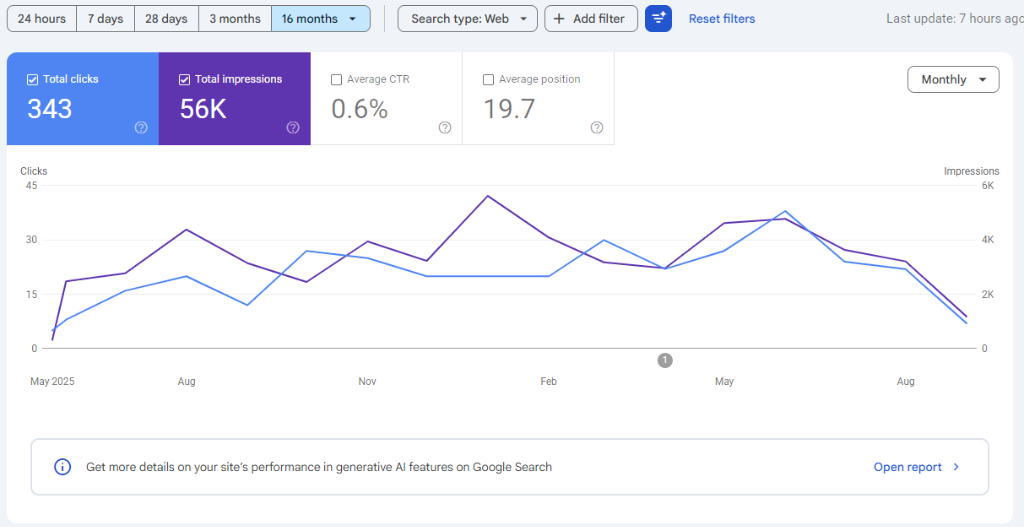
That means the average result is sitting around page two of Google.
Again, that doesn't sound spectacular until you consider what the queries are.
These aren't obscure made-up keywords.
Glow Index can appear around searches involving some of the largest names in beauty.
And I've done very little deliberate SEO work to make that happen.
The site's overall CTR sits around 0.6%, which leaves plenty of room for improvement.
Titles could be better.
Descriptions could be tested.
Internal linking could be improved.
Pages with strong impressions but weak click-through rates could be targeted individually.
Structured data could be expanded.
There are dozens of traditional optimizations I could still make.
But that almost makes the experiment better.
Glow Index didn't get its initial visibility because I perfectly optimized it.
It got visibility because there was something worth indexing.
→ Maybe SEO Is Becoming Product Development
For a long time, SEO has been treated primarily as a marketing discipline.
Build website.
Then optimize website.
Find keywords.
Write articles targeting keywords.
Acquire links.
Adjust metadata.
Repeat.
Glow Index makes me think the more durable approach might increasingly look like product development.
Instead of asking:
What article should I write for this search?
Ask:
What useful thing could I build for the person making this search?
Someone searching for opinions about a $45 foundation probably doesn't need another generic article explaining what foundation is.
They may want to know:
- Do people actually like it?
- What complaints keep appearing?
- Would people buy it again?
- What does Reddit think?
That is a product problem as much as it is a content problem.
Software can answer it better than another 2,000-word SEO article.
→ Search Engines Like Relationships
One of my favorite aspects of Glow Index is how naturally its data creates relationships.
A Reddit comment relates to a product.
A product relates to a brand.
A product belongs to a category.
Many comments create sentiment.
Many products create brand sentiment.
Brands and products then connect back to related discussions.
Instead of producing isolated articles, the site creates a small knowledge graph around beauty products.
That has benefits for users, but it also happens to create exactly the kind of structure search engines can understand.
A crawler isn't discovering one article about mascara.
It's discovering:
$$\text{Mascara} \rightarrow \text{Maybelline} \rightarrow \text{Lash Sensational} \rightarrow \text{Reddit discussions} \rightarrow \text{sentiment} \rightarrow \text{related products}$$
The SEO architecture emerges from the application architecture.
As a software engineer, I find that much more interesting than traditional content marketing.
→ The Site Is Useful Even Without Google
This may be the most important test.
If Google disappeared tomorrow, would Glow Index still have a reason to exist?
I think it would.
Someone interested in a beauty product can still look it up and see what people have been saying.
They can compare the positive and negative conversations surrounding products.
They can discover which products repeatedly appear in recommendations.
They can browse brands and categories without reading dozens of separate Reddit threads.
Search traffic is valuable.
But search isn't the product.
The data is the product.
And I suspect that's one of the reasons the site has been able to gain visibility without much deliberate optimization.
→ Build Something Worth Searching For
Glow Index isn't a giant website.
I haven't dedicated a full-time SEO campaign to it.
Its 0.6% CTR gives me a long list of things I could improve, and an average position of 19.7 means there is significant room to move many searches onto the first page.
But that's exactly what makes it an interesting experiment.
It already has a foundation.
Not because I figured out some secret Google trick.
Not because AI generated thousands of articles.
Not because I spent months manufacturing backlinks.
I found an existing behavior—people searching Reddit for honest opinions about products—and built software around it.
AI made it possible to process those conversations at a scale that would have been impractical manually.
Next.js made it possible to turn that structured information into indexable pages.
Reddit supplied the human experiences.
Google found the relationships between them.
The result taught me a lesson I think applies far beyond beauty products:
Good SEO ideas are often good product ideas first.
If people are already asking a question, and you can build a better way to answer it, you may not need to manufacture demand.
The demand is already there.
You just have to organize it.
See how this approach was used in a production system.
Explore the problem breakdown, technical implementation notes, and quantifiable outcomes.