Elder Winds
A 3D dark-fantasy game built in Godot—and an experiment in how far software engineering fundamentals can take you when you start with almost no knowledge of the language or engine.
Summary
I started Elder Winds in July 2026 with a simple question: how much does knowing a programming language actually matter if you already understand software engineering?
To find out, I decided to build something far outside my normal web development stack: a fully 3D game in the Godot game engine.
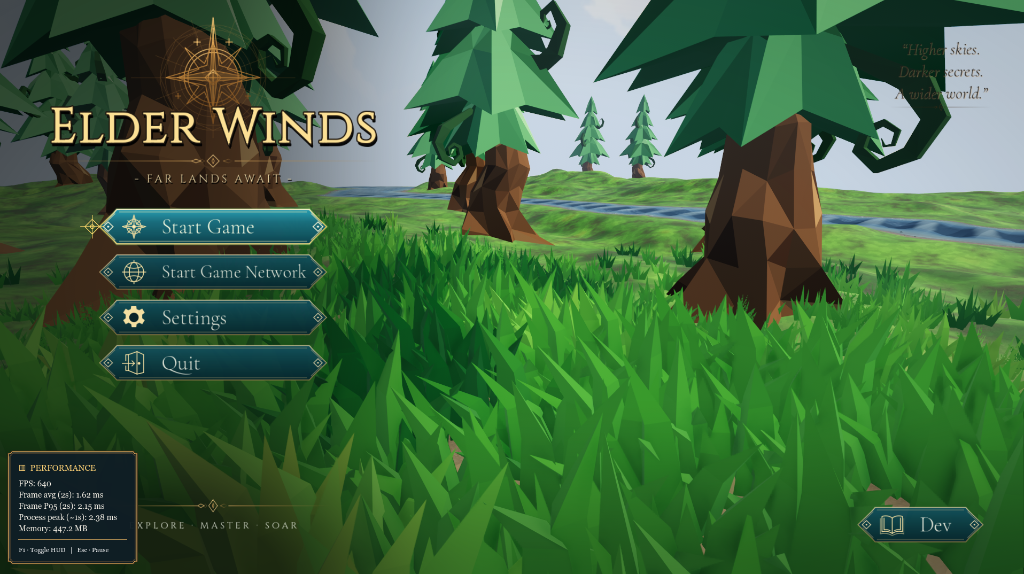
Elder Winds is a spiritual successor to the classic Magic Carpet, reimagined inside a lore-rich eldritch dark-fantasy world. The game centers around high-speed 3D movement, magical combat, exploration, strange creatures, rival sorcerers, and an increasingly hostile supernatural world.
Problem Solved
Modern software development is increasingly less about memorizing syntax and more about understanding architecture, systems, debugging, abstraction, and how pieces of software interact. Elder Winds is my attempt to push that idea to an extreme: instead of learning through isolated tutorials, I started building a real game and learned the engine, scripting environment, 3D mathematics, game architecture, physics, AI, and rendering systems as the project demanded them. The goal is to explore how transferable software engineering skills really are when the language, engine, and problem domain are completely unfamiliar.
Key Features
- 3D aerial movement inspired by Magic Carpet
- Fast-paced spell and projectile combat
- Eldritch creatures and dark-fantasy environments
- Rival wizard and enemy AI systems
- A lore-heavy world built around exploration and cosmic horror
- Modular systems designed to grow as the game evolves
Architecture Notes
What I Learned
- →Programming syntax is often the easiest part of entering a new technology stack.
- →Architecture, debugging, state management, and decomposition transfer surprisingly well between web development and game development.
- →3D games introduce entirely new problems—vectors, transforms, physics, animation, shaders, AI, and real-time simulation—but they are still software systems that can be broken into manageable pieces.
- →Building a real project forces deeper learning than studying a language in isolation.
Future Improvements
- +Expanded spellcrafting system and dynamic elemental combinations
- +Procedural biome generation for shifting cosmic horror environments
- +Advanced tactical AI behaviors and cooperative rival wizard encounters